

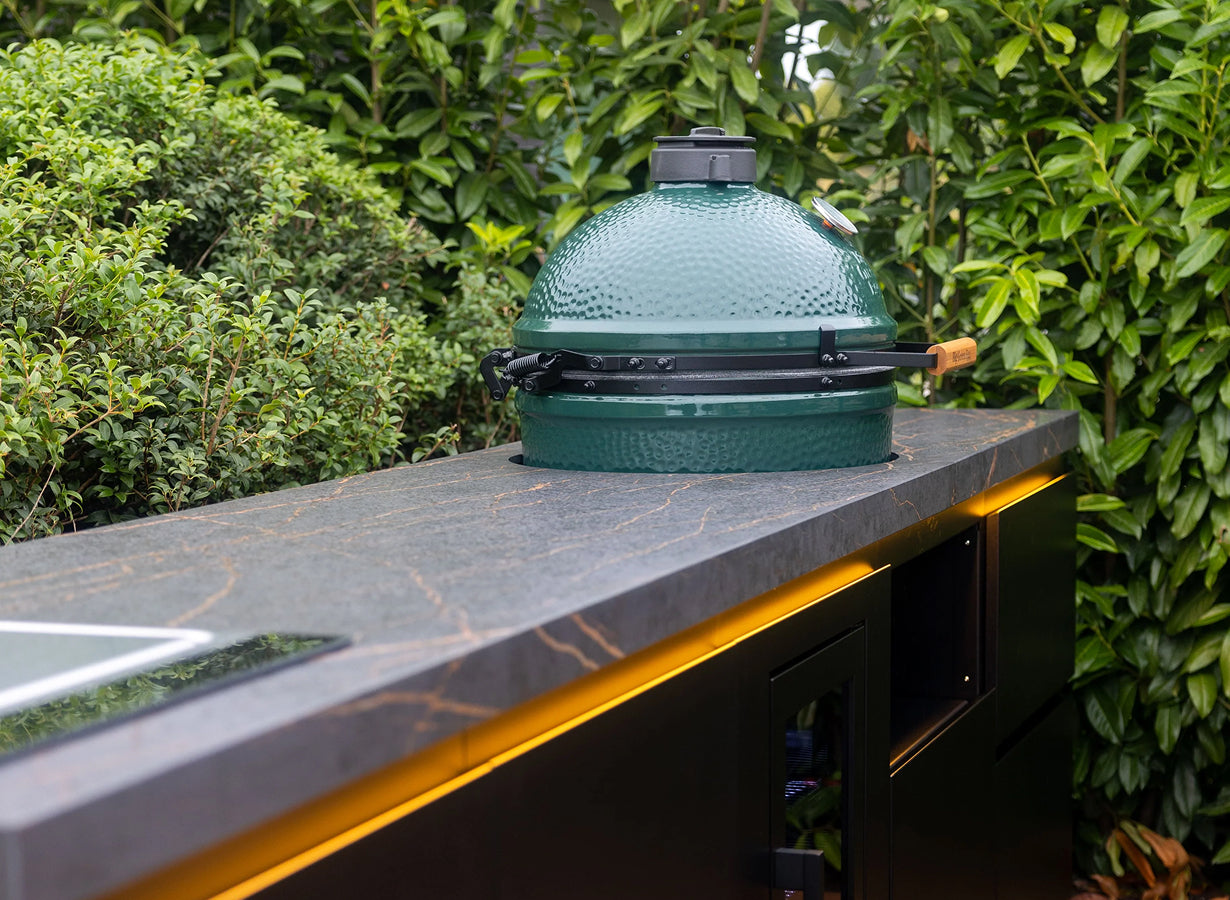
The worktop forms the heart of every outdoor kitchen. It is where everything happens, from preparation to serving. A good choice means years of worry-free cooking enjoyment. A wrong choice? You'll notice it every time you cook outdoors.
Why your worktop choice is so important
Sustainability determines your enjoyment
Your worktop takes the brunt of all the components. Intense sun on summer days, rain in the autumn, frost in the winter, and then heat of 250 degrees when you place a hot pan on it. A worktop that cannot withstand this will quickly show discoloration, cracks, or other problems. This is not a cosmetic issue; it determines whether your outdoor kitchen will still look as good in 10 years as it does now.
Most people underestimate the impact Dutch weather has on materials. What works perfectly indoors can be unsightly outdoors within a year. Therefore, the choice of material for an outdoor kitchen worktop is fundamentally different from that for indoors.
Ease of use in practice
A worktop is more than just a beautiful surface. It determines how pleasant it is to actually work on. Can you cut on it easily? Is it easy to clean after a BBQ? Do you have to constantly watch out not to damage anything? These daily experiences accumulate and determine whether your outdoor kitchen becomes a source of pleasure or frustration.
Consider how you use the worktop. You work differently in an outdoor kitchen than indoors. More people gather around, you frequently place hot items directly on the surface, and the worktop regularly becomes a sort of buffet where guests grab their plates. Therefore, it must be able to withstand more intensive and less careful use.
The visual impact
Your countertop largely determines the appearance of your outdoor kitchen. It is literally the largest surface you see. The wrong color or texture can disrupt your entire garden design, while the right choice brings everything together and makes your outdoor kitchen a natural part of your garden.
And it goes beyond just being beautiful. A worktop that fits your garden perfectly feels natural. One that doesn't quite fit always feels a bit strange, even if you can't pinpoint exactly why.
The biggest mistakes when choosing a worksheet
Mistake 1: Choosing based on appearance alone
The most common mistake? Choosing a worktop because it looks luxurious in the showroom. For example, a high-gloss top that looks elegant and chic. But in practice, this leads to concrete problems.
The glare problem
Glossy countertops reflect sunlight like a mirror. Just try cooking when the sun is shining directly into your eyes via your countertop. It is not only annoying, it makes outdoor cooking on sunny days almost impossible. And let's be honest, those sunny days are precisely when you want to use your outdoor kitchen.
Stains and maintenance
High gloss reveals everything. Every droplet of water, every greasy fingerprint, every crumb. Indoors, you can constantly keep up with that, but what about outdoors? With guests around and a BBQ that needs attention. High gloss can cause problems more quickly than a matte finish. We are happy to advise you on this.
Sustainability under pressure
Some materials that look beautiful are simply not made for outdoor conditions. They can discolor due to UV radiation, crack due to temperature fluctuations, or start to rust due to moisture. You only notice this after months or a year, but by then it is too late.
Mistake 2: Forgetting to think about timelessness
What you find trendy and beautiful now might feel different in a few years. This is especially tricky with countertops because they are not easy to get rid of. They are installed, heavy, and replacing them costs money.
Many people choose countertops just like they buy clothes. What is trendy now feels good. But you don't wear a countertop for just one season; you have it for 10, 15, maybe even 20 years. Think about trends from 10 years ago. Would you still find them beautiful in your garden today?
The safe route
That doesn't mean everything has to be boring and neutral. But choose a base that is timeless, with perhaps some character in the details. Neutral colors with interesting texture are often safer than bright, patterned colors. Unless you really know that you will continue to appreciate that bold choice for years to come.
Mistake 3: Not including the garden in your choice
Your outdoor kitchen does not stand alone. It is part of a larger whole: your garden, your patio, and the house behind it. A worktop that is beautiful in itself but does not fit with the rest disrupts the harmony.
Look at the colors you already have. What is the color of your tiles? Your garden furniture? Your fence? What atmosphere does your garden have—modern and sleek, or naturally wild? The countertop should complement this, not clash with it.
Which materials are suitable for outdoors?
Why not every material works
Indoors, you have endless choices for countertops. Wood, composite, natural stone, synthetics—you name it. But outdoors? The list gets dramatically shorter. Most materials simply cannot withstand the combination of sun, rain, frost, and heat.
Wood cracks and weathers. Much natural stone discolors or becomes porous. Synthetics can become brittle due to UV exposure. Only a select group of materials has been specifically developed to withstand outdoor conditions.
Professional outdoor kitchen equipment
Serious outdoor kitchen manufacturers work with materials such as Dekton, Florim, or Neolith. These are not natural stone or synthetic materials, but compressed minerals produced under extreme pressure and temperature. The result is a material that:
Is extremely heat-resistant
You can place a pan directly from the BBQ onto the worktop without a trivet. Up to 250 degrees is no problem. That is practical, because when cooking outdoors, you constantly place hot items on it.
Resists all weather conditions
Sun, rain, frost, temperature fluctuations. It does not discolour, crack, rust, or weather. It simply stays beautiful.
is scratch and stain resistant
You don't have to be careful. Cut on it roughly (although a cutting board is always better), spill on it, let it get wet. It will still look the same.
Style choices: what suits your garden?
Modern and industrial
For modern gardens with clean lines, work with neutral colors and smooth textures. Black countertops give a professional look, a concrete look complements contemporary architecture, and shades of gray are versatile and timeless.
This style suits gardens with plenty of natural stone, neatly trimmed hedges, and modern garden furniture. The contrast with greenery works well, and the clean lines reinforce the orderly character.
Natural and warm
For gardens that feel more organic and natural, work with warm tones and natural variations. Light countertops with earth tones, brown-tinted materials, or countertops that imitate natural stone fit well here.
This works well in gardens with plenty of wood, natural planting, and a less rigid layout. The worktop should feel like a natural element, not something placed in the garden.
Luxury and statement
Some people want their outdoor kitchen to stand out. In that case, you choose countertops with striking veins, unique colors, or dynamic patterns. Think of deep black countertops with gold veins, or countertops that resemble exclusive marble.
This works if your outdoor kitchen is the centerpiece of your garden and you consciously want to make a design statement. However, it does require that the rest of your garden can handle it, otherwise it becomes too busy.


Maintenance: keep it practical and simple
Daily maintenance
The good news: modern outdoor kitchen worktops require almost no maintenance. Wiping with water and a soft cloth after use is usually enough. Stubborn stains come off with a little mild dish soap.
No special products, no periodic treatments, no complicated rituals. Just clean and you're done. This is a major difference compared to, for example, wooden countertops that need to be oiled regularly, or natural stone that needs to be sealed.
What you should avoid
Do not use scouring pads or harsh chemicals. This is unnecessary and can dull the surface. The countertops are so hard that normal cleaning agents are not needed. Water and soap work perfectly.
Also, do not use sharp objects directly on the surface. Although the worktops are scratch-resistant, using a cutting board remains advisable. This keeps the worktop in perfect condition and also provides a more pleasant cutting experience.
Long-term protection
How long your worktop lasts also depends on protection. A canopy over your outdoor kitchen helps enormously. Not because the worktop can't handle it, but because constant exposure to extreme conditions does take its toll in the long run.
A good cover for the winter is also sensible. It is not necessary, but it extends the lifespan. Especially if you do not use your outdoor kitchen for months, it prevents dirt and leaves from accumulating.
The three most important questions for your choice
1. What do I find really beautiful?
Many people don't choose what they truly find beautiful. They choose what is safe, what the neighbors have, or what we recommend. But an outdoor kitchen is an investment for years. Choose what makes you happy every time you look at your outdoor kitchen.
2. Will this still be suitable in 10 years?
Imagine it is 2035. Will you still be standing at this workbench with pleasure then? Or are you already thinking, "this is trendy now, but in a few years..."? If you have doubts, it is probably not timeless enough.
Look at classic choices from the past that are still beautiful today. Natural colors, subtle patterns, high-quality materials. These continue to work because they are not dependent on trends.
3. How do I use this in practice?
Think about how you cook. Are you careful and neat, or rough and practical? Do you often have guests hanging around the kitchen, or do you usually cook alone? Is your kitchen in direct sunlight or under a canopy?
These practical considerations determine which worktop suits you best. Someone who is always careful can afford a high-gloss finish. Someone with children who constantly touch the worktop with their hands might want something that shows stains less easily.
The selection process: step by step
Step 1: Determine your style
Start by determining the desired look. Modern, natural, luxurious? This already significantly narrows down your choices. Create a mood board with photos of gardens and outdoor kitchens that you like. Which countertops do you see recurring?
Step 2: View materials in real life
Colors look different in real life, textures feel different. Visit showrooms, check with dealers, go to the Roostr studio. Feel the materials, see them in real light, ask questions.
Step 3: Test with your garden
If you have a few favorites, try to visualize how they would look in your garden. In the Roostr Studio, we have samples you can borrow temporarily. Place them next to your patio tiles, hold them up against your fence. Do they fit?
Step 4: Think about the future
What if you redo your garden in 5 years? Will this worksheet still work? What if you move, does it suit different garden styles? A little flexibility helps.
Working with professional advisors
use 3D visualizations
Modern configurators show you the final result before you buy. You see your outdoor kitchen with various worktops in your own garden. This helps enormously in making a decision.
At Roostr, for example, you can try out various worktops in the configurator and even place them in your own garden using VR. This way, you see exactly how big it will be and what it looks like.
Can you change it later?
Replacing worktops
Yes, countertops can be replaced later. It is not the most sustainable or cheapest option, but it is possible. Perhaps your taste changes, perhaps you redecorate your garden, or perhaps you simply want something new after 10 years.
With modular outdoor kitchens, this is easier than with masonry structures. The worktop is not fixed in concrete but is mountable, which makes replacement possible without demolishing the entire kitchen.
Avoid regret
The best strategy is, of course, to make the right choice immediately. You do this by:
-
Think carefully about timelessness
-
To choose materials that are proven
-
Ask for advice if you are in doubt
-
To choose your own taste, not trends
Making the right choice
Choosing a worktop for your outdoor kitchen is a balance between practical requirements, personal taste, and long-term thinking. Choose materials proven for outdoor use, consider how you will actually use it, and select a style that suits your garden and is timeless enough for years of enjoyment.
The technical side is relatively simple. There are a few materials that work, the rest don't. Within those materials that work, you have enough choice in colors and styles to get exactly what you want.
The difficult part is the emotional decision. What do you find beautiful? What suits you? What feels right? There is no formula for that. You have to discover that for yourself, ideally by seeing materials in real life and taking your time to make the decision.
Because food tastes better, especially when your countertop perfectly matches your lifestyle and cooking style.
Would you like to see and feel different worktops in real life? Visit the Roostr studio for personal advice, or Find a dealer near you. Also check out the configurator to visualize various options.
How to choose the best outdoor kitchen: a complete guide to the right choice
What is the average cost of an outdoor kitchen? Setting a realistic budget