

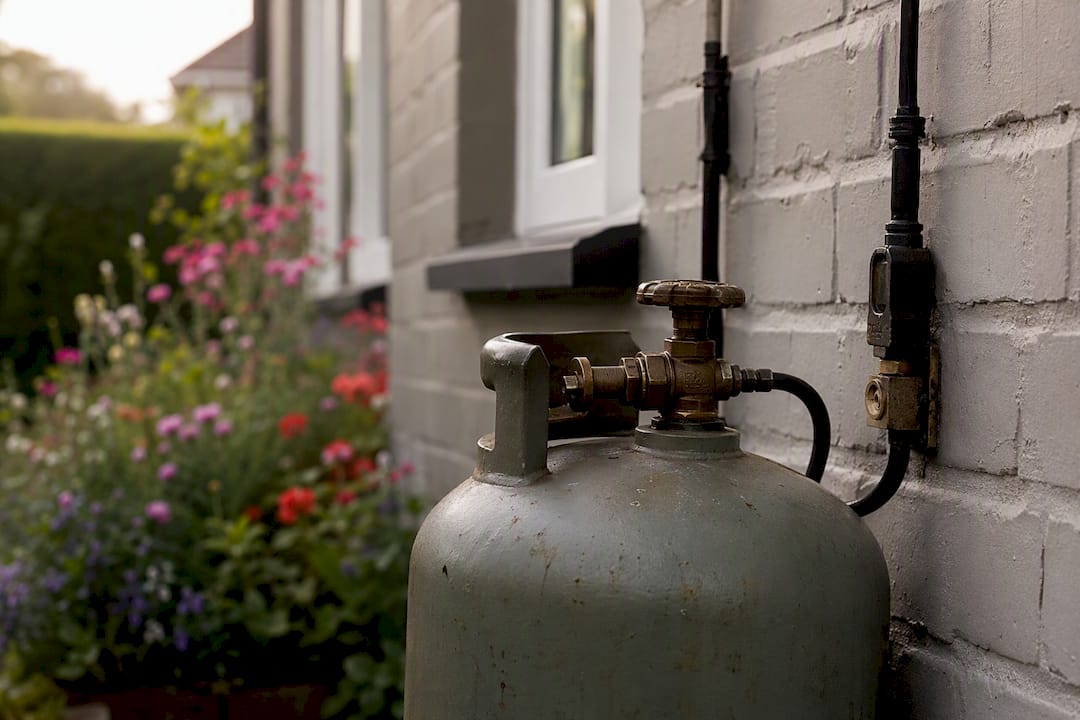
If your property has a mains connection, natural gas is almost always the cheaper, simpler choice. If it doesn’t, LPG (usually propane) is the practical fallback, though it costs more to run. Either way, appliance conversions and installation work must go through a Gas Safe registered engineer.
TL;DR:
- Mains natural gas is typically cheaper and more convenient if your property has access to the network, eliminating storage and delivery costs.
- LPG requires storage in cylinders or tanks and involves higher ongoing costs due to delivery fees, rental, and regional price fluctuations.
- Appliances designed for natural gas cannot be simply swapped to propane without proper conversion, as they operate at different pressures and combustion characteristics.
- For off-grid properties, LPG is the only practical fuel option, with tank size and siting regulations depending on usage needs and legal restrictions.
- Both fuels have limited environmental benefits compared to electrification options like heat pumps, which are more sustainable for long-term decarbonization.
Table of Contents
- Natural gas vs propane: what each fuel actually is
- Energy content and interchangeability: MJ, BTU and the Wobbe index
- How to compare running costs properly
- Availability and delivery: why grid access decides everything
- Safety and UK regulatory essentials
- Environmental impact: neither fuel is the long-term answer
- Decision checklist: which fuel fits your property
- What we’ve learned fitting gas into outdoor kitchen builds
- Building gas cooking into a kitchen that lasts
- Sources
Natural gas vs propane: what each fuel actually is
Natural gas is a methane-dominant fossil fuel delivered to homes through the mains pipeline network and metered like electricity. LPG, or liquefied petroleum gas, is a different chemical mix entirely, and in UK domestic settings it’s almost always propane rather than butane, because butane stops vapourising properly once temperatures drop below 0°C. That makes it useless in a permanent outdoor tank through a British winter, which is exactly why suppliers default to propane for off-grid homes.
The delivery method is the practical difference you’ll notice day to day:
- Natural gas: continuous supply via the mains network, billed through a meter, no storage needed on-site.
- LPG/propane: stored in cylinders or a bulk tank, refilled by tanker or cylinder exchange.
Both fuels power the same domestic appliances, boilers, hobs, and outdoor grills among them, but they are not interchangeable without proper conversion work.
Energy content and interchangeability: MJ, BTU and the Wobbe index
Propane packs roughly 93.2 MJ/m³ of energy against natural gas’s 38.7 MJ/m³, more than double the energy per cubic metre. That sounds like an obvious win for LPG, but volume isn’t the whole story.
The numbers that matter: LPG delivers about 93.2 MJ/m³ versus natural gas’s 38.7 MJ/m³, yet UK domestic systems run natural gas at roughly 21 mbar and LPG at around 37 mbar after the first-stage regulator.
Appliances are engineered around a specific pressure and a specific combustion characteristic known as the Wobbe index, which governs how much energy actually reaches the burner and whether it combusts cleanly. Because LPG runs hotter and denser, an appliance built for natural gas will burn incorrectly, or dangerously, on propane without the right injectors and regulator settings. This is why plug-and-play swaps between the two fuels don’t exist.
How to compare running costs properly
Comparing the price per litre of LPG against the price per unit of natural gas tells you almost nothing useful. You need both figures converted into pence per kWh before any comparison means anything, because that’s the only measure that accounts for the energy density difference described above.
Once you do that conversion, the pattern is consistent: natural gas is generally cheaper to run than LPG for most UK households, despite propane’s higher calorific value. The gap comes down to what LPG carries on top of the fuel itself:
- Delivery charges for tanker refills or cylinder exchange.
- Tank rental fees, which many suppliers charge annually even when you own the property.
- Logistics costs baked into regional pricing, since LPG has to be transported rather than piped.
LPG pricing is also more volatile and varies more by region than mains gas, because transport and storage costs shift with fuel prices and local supply chains in a way that a national gas grid simply doesn’t; for professional installation advice, consider hot water cylinder installation services to manage your LPG systems effectively. If you’re budgeting for a rural property, build in a buffer for that unpredictability rather than assuming last year’s price holds.
Availability and delivery: why grid access decides everything
For most homeowners, the choice between natural gas and propane isn’t really a choice at all. It’s decided by whether the property sits on the mains network, and tradespeople will tell you the same thing: the “better” fuel is whichever one is already available at the address.
Roughly 1.7 million UK homes rely on LPG as their primary fuel, and the overwhelming majority of them sit in rural, off-grid areas where extending the mains network was never commercially viable. If that’s your situation, your practical options are a bulk tank (typically several hundred to over a thousand litres, sited above ground) or cylinder exchange for lighter use.
- Above-ground tanks are standard; underground siting isn’t permitted for domestic LPG.
- Tank rental is common even when you buy the gas outright from a different supplier.
- Bulk tanks suit whole-house heating; cylinders suit occasional cooking or backup use.
Check your postcode against network coverage maps before assuming either option. Some properties sit tantalisingly close to a mains connection that was never actually extended to their boundary.
Safety and UK regulatory essentials
LPG vapour is heavier than air and pools at low level rather than dispersing upward, which is the opposite of how a methane leak behaves since natural gas rises and disperses. That single fact shapes almost every LPG safety rule: tank siting, ventilation, and low-level detection all exist because a propane leak collects in cellars, pits, and enclosed spaces rather than escaping upward.
- LPG installation work must comply with IGEM/UP/1C for pipework sizing and DSEAR 2002 for dangerous substance handling.
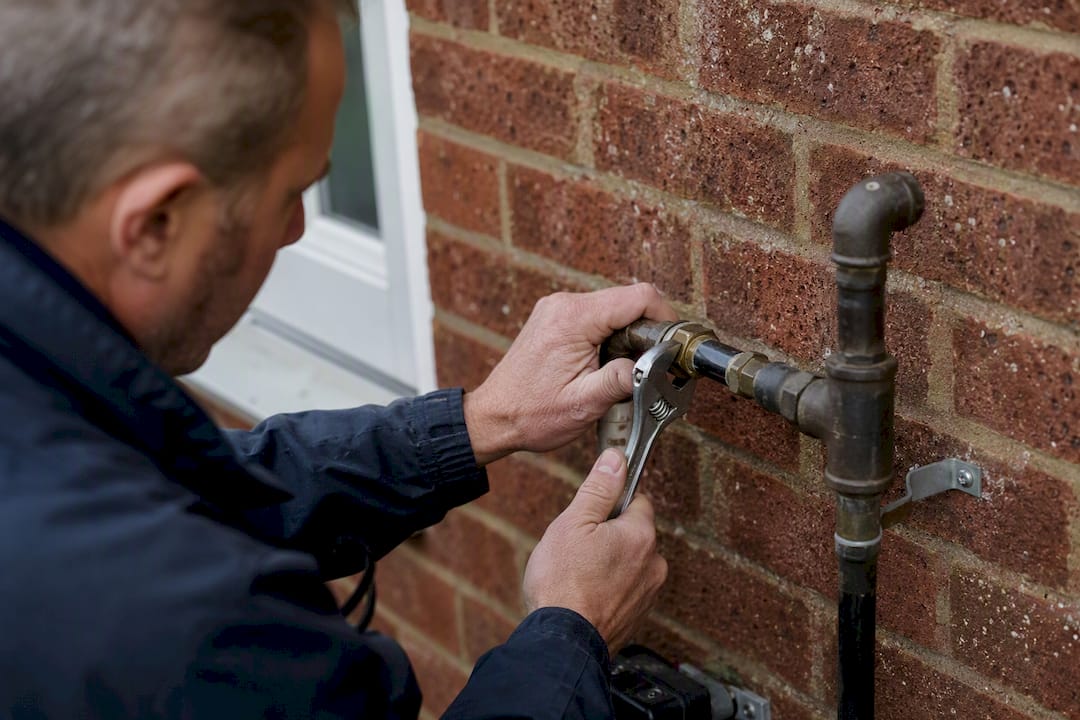
- Only Gas Safe registered engineers holding an LPG-specific category can legally carry out installation, conversion, or repair work.
- Underground tank siting is banned; pressure relief valve discharge paths must stay clear at all times.
- Large tanks or certain siting arrangements may need planning or Environment Agency notification, depending on volume and location.
A lawful appliance conversion means changing injectors and jets, resetting the regulator for the correct pressure, and finishing with a documented Gas Safe completion certificate that records the conversion kit reference and appliance serial number.
Pro Tip: Never assume a “universal” appliance works on both fuels out of the box. Always ask your installer to confirm in writing which gas type the unit is currently configured for before you connect anything.
Environmental impact: neither fuel is the long-term answer
Both natural gas and propane are fossil fuels, and swapping one for the other won’t meaningfully change your household’s carbon footprint. The more useful comparison isn’t propane vs natural gas at all, it’s gas vs electrification.
- LPG burns cleaner in some high-heat industrial contexts, but that advantage rarely translates into a domestic carbon win.
- A condensing boiler with proper servicing and modern controls cuts emissions on either fuel without switching anything.
- For genuinely off-grid homes, heat pumps are increasingly the more effective long-term route than choosing between two gas types.
If carbon reduction is your priority rather than convenience or upfront cost, treat this whole comparison as a stopgap question, not the destination.
Decision checklist: which fuel fits your property
Work through these points in order before you commit to either fuel or a switch between them:
- Check grid access first. If mains gas reaches your boundary, that settles most of the cost question immediately.
- Estimate annual usage. Heavy heating demand changes the tank size and delivery frequency you’ll need with LPG.
- Assess tank space and planning rules. Above-ground siting needs clearance from buildings and boundaries.
- Weigh upfront versus ongoing costs. LPG installation can be cheaper initially; running costs usually aren’t.
- Factor in your carbon priorities. If that matters more than convenience, ask about heat pump feasibility before locking into either gas.
Three quick scenarios: an urban semi with mains access should stick with natural gas; a rural farmhouse with no grid connection nearby is a realistic LPG candidate; a self-build prioritising low carbon should get a heat pump quote before signing any gas contract.
Pro Tip: Ask any installer quoting for LPG work to show you their Gas Safe ID card and confirm the specific LPG category they’re registered for, not just their general Gas Safe number.

What we’ve learned fitting gas into outdoor kitchen builds
Homeowners often assume the fuel decision is separate from the outdoor kitchen design. It isn’t. Roostr routinely plans tank and pipework routing into custom builds from the first conversation, coordinating directly with Gas Safe engineers so siting, ventilation, and servicing access are right from day one.
— Liam
Building gas cooking into a kitchen that lasts
Whichever fuel your property runs on, the outdoor kitchen around it needs to handle real weather and real cooking, not just look good on day one. Roostr designs modular stainless and galvanized steel kitchens with gas-compatible cabinetry built in from the start, so your barbecue or hob sits in a housing engineered for it rather than bolted on as an afterthought.

If you’re planning a build around a gas barbecue, the Cabinet Kamado Drawer 70x70cm gives you a weatherproof housing designed to work with standard cylinder or bulk tank setups, and the Cabinet Flammkraft Gas 100x60cm shows how supply routing looks in a finished layout. This is about outdoor cooking, not central heating, so if you’re weighing up whole-house options, speak to a heating engineer first. For the outdoor kitchen itself, request a design consultation and Roostr will talk you through siting and gas integration for your specific space.
Getting pizza oven integration right in your outdoor kitchen
Why stainless lasts 25–30 years outdoors — granite vs quartz worktop